
Short answer
A commodity trading company's website is not a sales page. It is a due-diligence checkpoint. Before a buyer sends an RFQ, a supplier shares an offer, or a bank opens a trade finance line, someone on their side looks you up. What they find decides whether the conversation starts.
The UAE makes this harder, not easier. Thousands of trading companies are registered across Dubai, Ras Al Khaimah, Abu Dhabi and the free zones, and many look identical online: a stock photo of a port, a list of commodities, and a Gmail address. Serious counterparties have learned to filter those out fast.
This guide covers what a UAE trading house's website actually needs: who visits it and what they check, the pages that matter, the trust signals that separate you from paper traders, how to design inquiries so the right ones reach your desk, and the technical basics. It ends with how we applied this for Nine Power and its sister company Gulf Link Trading, and a checklist you can use on your own site.
Most deals don't start on your website
Be realistic about what the website is for. Physical commodity trade runs on relationships: traders work buyers and suppliers daily by phone, WhatsApp and email, meet them face to face, and pick up new counterparties through referrals, brokers and trade shows such as Gulfood. Very few cargoes are booked because a stranger found you on Google.
What the website does is the step after the introduction. Someone gets your name from a contact or a business card, then looks you up. Their compliance team checks your full legal name, registration details and ownership against independent sources before any contract. If your site is missing, vague or inconsistent with your licence, the conversation stalls there.
So design for that person: the one who already has your name and is deciding whether you're real. That means:
- Verification in one click. Legal name, licence and address easy to find, matching your documents exactly.
- A downloadable company profile. Counterparties often ask for one during onboarding. Put it on the site so your traders can send a link.
- The channels traders actually use. A direct phone and WhatsApp number for the desk, not only a form.
- Consistency with LinkedIn. The trader they met will be checked there too, so names, titles and the company page should line up with the site.
Search traffic is a bonus on top of this, mainly from buyers searching for a specific product and origin. The rest of this guide is built around both jobs: passing verification and catching that search demand.
Who visits a trading company's website, and what they check
Almost nobody browses a trading company's website for fun. Each visitor arrives with one question, and the site either answers it in under a minute or loses them.
| Visitor | Why they're there | What they check first |
|---|---|---|
| Buyers and importers | Deciding whether to send an RFQ | Which commodities you handle, origins, destination markets, who to contact |
| Producers and suppliers | Deciding whether to offer you cargo | Whether you're a real off-taker with volume, not a broker chain |
| Banks and trade finance teams | Onboarding or reviewing a credit line | Legal entity name, licence, registered address, leadership |
| Compliance and KYC teams at counterparties | Screening you before a contract | Same as banks, plus compliance and sanctions statements |
| Logistics, inspection and insurance partners | Assessing a new relationship | Scope of operations, regions, how established you are |
| Hires and agents | Judging if you're credible to work with | About page, leadership, physical presence |
The pattern is clear: most visitors are verifying, not shopping. A trading site wins by making verification easy, then giving each type of visitor a direct route to the right person.
The pages a trading company's website needs
You don't need a big site. Six to ten well-built pages beat forty thin ones. These are the ones that do the work:
- Home. One sentence on what you trade and where, your divisions, your base, and a clear route to the trading desk. A visitor should know what you do before they scroll.
- A page per division or commodity group. Agriculture, energy, metals, fertilizers, petrochemicals: whatever you actually trade. Each page lists the specific products, typical origins and destinations, and the standards they move under. These pages also do most of your SEO, because buyers search for products, not company names.
- About / company. Legal entity name exactly as on the licence, licensing authority and free zone, year established, and the people behind the company. Faceless trading companies get screened out.
- Standards and compliance. The regulatory frameworks you trade under for each commodity type, plus your stance on KYC, AML and sanctions screening. Short and specific beats long and vague.
- Markets and network. Where you source from and supply to. A simple map or region list is enough.
- Contact / trading desk. Not just a form: a physical address, a company-domain email, a phone number, and inquiry routing by division (more on this below).
- Legal pages. A real privacy policy and terms. Compliance reviewers notice when these links go nowhere.
Optional but useful once the basics are solid: market updates or insights, a careers page, and downloadable company profile or credentials for counterparties who need them for onboarding.

Trust signals that matter in UAE commodity trade
In this industry, trust is built with facts a counterparty can verify, not with adjectives. “Leading global trading house” means nothing to a compliance officer. A licence number does.
The signals that actually move a counterparty:
- Verifiable legal identity. The registered company name, licensing authority (for example a free zone such as RAKEZ, DMCC, JAFZA or ADGM, or a mainland department of economic development) and the registered address. These should match your trade licence exactly.
- A company-domain email. trading@yourcompany.ae, never a Gmail or Hotmail address. This is one of the fastest filters counterparties use.
- Specific compliance content. Name the frameworks you trade under per commodity: food safety and phytosanitary rules for agri products, registration and import controls for fertilizers, chemical regulations for petrochemicals. Specifics read as real; generic “we follow the highest standards” reads as copied.
- Real people. Named leadership with roles. Photos help. LinkedIn links help more.
- Physical presence. An office address that exists on a map, not a PO box alone.
- Consistency everywhere. The same name, address and contact details on your site, your licence, LinkedIn and Google. Mismatches raise flags in KYC reviews.
What to avoid: stock photos passed off as your own facilities, volume or turnover claims you can't back up, and logos of “partners” you've only had a call with. Experienced counterparties check, and one inflated claim undermines everything else on the page.
Designing inquiries that reach the right desk
Most trading company contact forms ask for a name, an email and a message. The result is an inbox full of spam, broker chains and vague “please send price list” emails, with the real inquiries buried in between.
A better inquiry flow does three things:
- Routes by division. A “select division” field (agriculture, energy, metals and so on) sends each inquiry to the right trader instead of a shared inbox.
- Separates buyers from suppliers. “I want to buy” and “I want to supply” are different conversations. One extra field lets you route and prioritise them differently.
- Asks a few qualifying questions. Company name, country, product and specification, indicative volume, and delivery terms (FOB, CFR, CIF). Keep it to what a trader needs to reply. Every extra field costs you some inquiries, so only ask for what you'll actually use.
Also say what happens next, for example “our trading desk replies within one business day.” It sets expectations and signals there's a real team on the other side.
The goal is not more inquiries. It's more inquiries you can act on. Fewer, better-qualified messages save your traders hours every week.
Technical and design essentials
The design should feel institutional: calm, precise and confident, closer to a bank than a startup. Beyond the look, these are the technical basics that matter for a trading house:
- Fast on any connection. Your counterparties open your site from offices, phones and ports across Africa, Asia and the Americas, often on slower networks. Compress images and video, and test load times outside the UAE.
- Mobile-first. Traders and procurement managers often check you on their phone between calls. Division pages and the contact route must work perfectly on a small screen.
- Arabic and English, if your market needs it. For GCC government-linked buyers and regional partners, a proper Arabic version (right-to-left layout, not machine translation) builds credibility. If your counterparties are mainly international, English-first is fine.
- SEO built in. Each division and product page needs its own title, description and headings using the terms buyers search for (“sunflower oil supplier UAE”, “urea fertilizer trading Dubai”). Add Organization schema with your legal name and address so search engines and AI tools describe you accurately.
- Security. HTTPS everywhere, spam protection on forms, and email authentication (SPF, DKIM, DMARC) on your domain. Trading companies are a common target for invoice fraud, and a spoofable domain puts your counterparties at risk.
- Easy to update. Products, markets and team change. You should be able to update division pages without calling a developer.
Case study: Nine Power Group
We've built two sites for the Nine Power Group: ninepower.ae for Nine Power, the group's Ras Al Khaimah free zone company, and gulflinkgcc.com for Gulf Link General Trading LLC, its Dubai trading company. After the Nine Power site launched, the group saw a 5x increase in verified international trade inquiries and institutional supplier outreach.
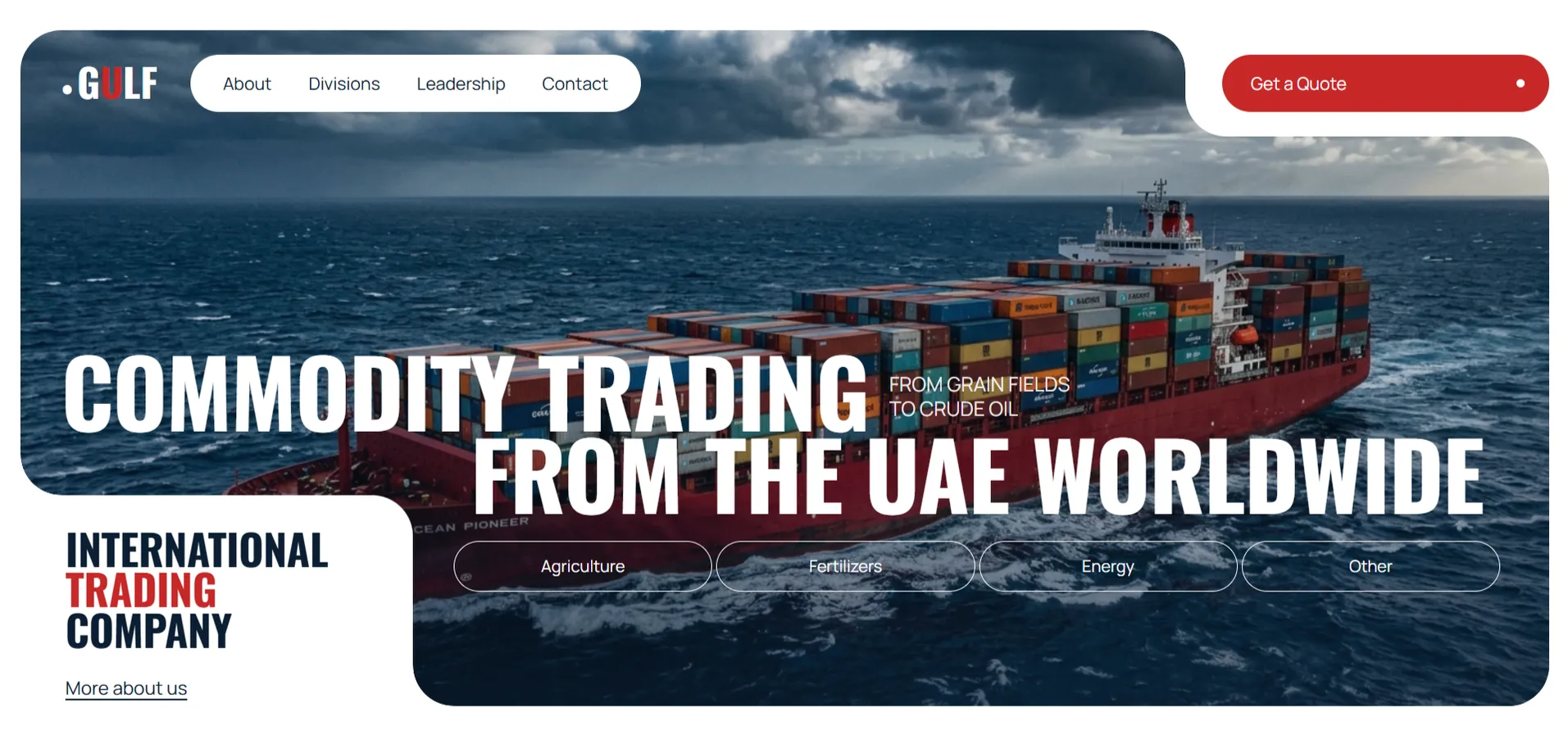
Gulf Link, our newer build, took about 10 days. The client had little content to share and had already approved a design template, so we put the time into making every page specific and verifiable. It puts most of this guide into practice:
- Verifiable identity. The full legal name, Gulf Link General Trading LLC, and the Dubai office address appear on every page, and the leadership page sets out its place in the Nine Power Group.
- Named leadership. A leadership page with a profile for each of the two people behind the group, so a counterparty knows who they're dealing with before the first call.
- Specific products. Each division lists what it actually trades. The fertilizers page, for example, names urea, ammonium-based, phosphate and potash fertilizers, NPK blends and agricultural conditioners, plus the registration and import approvals they move under.
- The channels traders use. A direct phone number and office hours sit next to the inquiry form, not just an email address.
- Inquiries routed by division. The contact form asks for the division and prompts for product, volume and destination, so the desk gets what it needs to reply.
- Product-led SEO. Every division has its own page title and a description naming its product groups, so a buyer searching for a product lands on the right page rather than the homepage.
Common mistakes trading company websites make
- Listing every commodity under the sun. “We trade oil, gold, sugar, cement, scrap and diamonds” is a classic sign of a broker chain. List only what you actually handle.
- A free email address. It is the fastest way to be filtered out by a serious counterparty.
- No legal identity. No registered name, licence or address means compliance teams can't verify you, so they move on.
- One generic contact form. Every inquiry lands in one inbox, unsorted, and good leads wait while spam gets read.
- Vague compliance language. “Highest international standards” without naming a single framework reads as filler.
- Stock imagery presented as your own. Illustrative imagery is fine. Captioning a stock port photo as “our terminal” is not, and experienced counterparties notice.
- Broken legal links. Privacy policy and terms links that go nowhere signal an unfinished business.
- A site that's never updated. Old leadership, discontinued divisions or a copyright year from 2021 make people wonder if you're still operating.
When there are no photos and few details
Many trading companies can't share much. Cargo photos are confidential, offices are small, and owners are private. That's normal, and a good site can still pass verification:
- Use honest visuals. Abstract commodity close-ups, maps of trade routes, or simple icons work well. Just don't label them as your own facilities.
- Let facts carry the copy. Replace claims like “leading trading house” with things nobody can dispute: what you trade, where you're licensed, which regions you serve, and how to reach the desk.
- Collect the minimum from the owner. A five-minute questionnaire usually unlocks enough: registered name and licence number, year established, specific products per division, main origins and destinations, and a direct phone number.
- Add detail over time. Launch with what's verifiable, then add leadership, credentials and a company profile as the client becomes comfortable sharing.
Checklist for your trading company website
- Home page says what you trade, where, and how to reach the desk
- A dedicated page for each division or commodity group
- Registered company name, licensing authority and address match your trade licence
- Company-domain email, phone number and physical office address
- Standards and compliance section naming specific frameworks
- Named leadership with roles
- Inquiry form routed by division, with buyer and supplier separated
- Expected response time stated on the contact page
- Loads fast on mobile and from outside the UAE
- SEO titles and descriptions on every division page, plus Organization schema
- HTTPS, form spam protection and SPF/DKIM/DMARC on your email domain
- Working privacy policy and terms pages
FAQ
How many pages does a trading company website need?
Usually six to ten: home, one page per division, about, compliance, markets and contact. Depth on each page matters more than page count.
Do we need an Arabic version?
If you deal with GCC government-linked buyers or regional partners, yes. If your counterparties are mostly international, English-first is fine and Arabic can come later.
Should we publish prices on the site?
Generally no. Commodity prices move daily and depend on volume, specification and incoterms. Invite qualified inquiries instead.
How long does a trading company website take to build?
It depends mostly on content and design. With an approved design template and a focused set of pages, it can take as little as two weeks; our Gulf Link build took about 10 days. A fully custom design with bilingual content usually takes 6 to 10 weeks. For costs, see our B2B website pricing guide for Dubai.
Build a website your counterparties trust
TakesTwice designs, builds and maintains websites for B2B companies across the UAE, including trading houses like Nine Power. If your website isn't bringing in the inquiries your desk should be getting, talk to us.